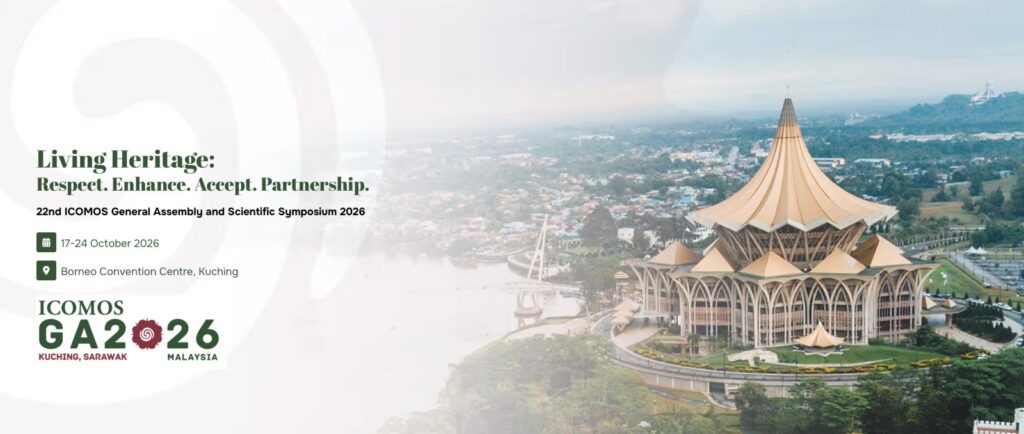

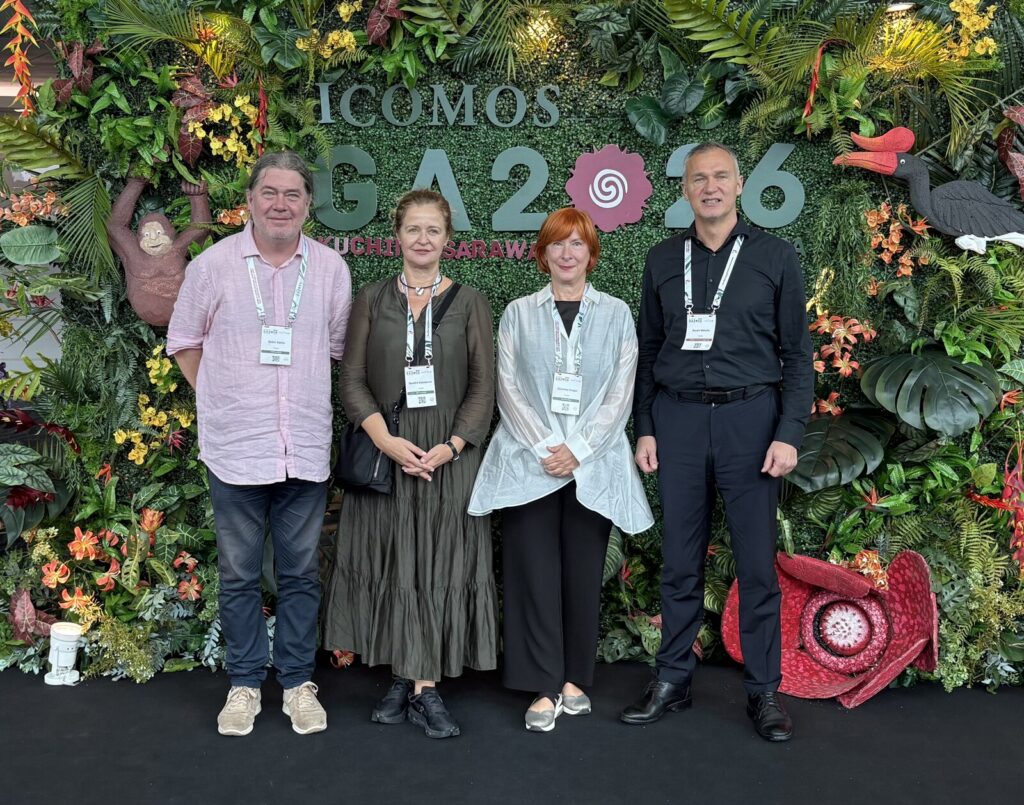
Croatian heritage professionals Sanjin Mihelić, Goranka Horjan, Darko Babić, and Sandra Uskoković are participating in the 22nd ICOMOS General Assembly and the accompanying International Scientific Symposium, taking place from 17 to 24 October 2026 in Kuching, Malaysia. Through their contributions to the scientific programme, international scientific committees, and other activities of the organisation, they are helping to promote the exchange of knowledge and experience while strengthening the presence of the Croatian heritage community within the international ICOMOS network.
This year’s Scientific Symposium, dedicated to the theme Living Heritage: Respect, Enhance, Accept, Partnership, addresses a wide range of issues concerning contemporary approaches to heritage conservation, management, and sustainable use, particularly in relation to local communities, climate change, tourism development, and the preservation of architectural heritage.
Croatian experts are contributing to the General Assembly through scientific presentations, participation in international committees, and involvement in the development and revision of ICOMOS doctrinal documents.
Sanjin Mihelić, President of ICOMOS Croatia and Director of the Museum of Arts and Crafts in Zagreb, delivered a presentation entitled Living Heritage and Community Resilience: Croatian Perspectives through the ICOMOS Charter for Cultural Heritage Tourism, co-authored with Goranka Horjan.
As part of a thematic session dedicated to cultural heritage tourism and community resilience, he presented Croatian experiences and challenges in applying the principles of the ICOMOS International Charter for Cultural Heritage Tourism, with particular emphasis on the relationship between heritage conservation, tourism development, and the interests of local communities.
Goranka Horjan, a member of the ICOMOS International Scientific Committee on Fortifications and Military Heritage (ICOFORT), delivered a presentation entitled A Value-Based Management Model for Archaeological Sites, introducing a management model based on the identification and assessment of heritage values. As part of the scientific programme addressing risk management, resilience and heritage sustainability, she highlighted the importance of this approach in setting conservation priorities and informing management decisions. Using Trakošćan as a case study, she explored the challenges of addressing cumulative pressures and the impacts of climate change. The presentation also relates closely to the work of ICOFORT, particularly in the conservation of multi-layered historic sites, risk management and balancing heritage protection with contemporary use.
Darko Babić, Vice-President of the ICOMOS International Scientific Committee on Interpretation and Presentation of Cultural Heritage Sites (ICIP), has been appointed Chair of the international working group responsible for revising the ICOMOS Charter for the Interpretation and Presentation of Cultural Heritage Sites (Ename Charter), adopted in 2008. This appointment represents a significant role for a Croatian expert in shaping ICOMOS international doctrinal documents. Established in February 2026, the working group aims to update the Charter in line with contemporary approaches to heritage interpretation and community participation. During the General Assembly in Kuching, progress on the revision was presented at the ICOMOS Advisory Committee meeting on 18 October. Babić’s involvement highlights the active contribution of Croatian experts to the development of international principles and standards for heritage conservation and interpretation.
Sandra Uskoković, Professor at the University of Dubrovnik and an expert member of the ICOMOS International Scientific Committee on Twentieth Century Heritage, contributed a presentation entitled Let It Go? Acceptance of Change and Modern Architectural Heritage in Southeast Europe: Scale, Limits of Preservation and Living Heritage in 20th-Century Architecture. Her paper explored the challenges of conserving modern architectural heritage, attitudes towards change, and the limits of conservation practice in contemporary society.
The participation of Croatian representatives in this important international gathering provides an opportunity not only to present national experiences and professional research but also to establish new contacts, develop international cooperation, and contribute directly to the work of ICOMOS International Scientific Committees and the development of international heritage conservation policies and principles.
For ICOMOS Croatia, strengthening such cooperation is particularly important, as is facilitating the exchange of international experience and good practices and their application within the Croatian heritage conservation and management system.